4/25/2016

Success! Solar Impulse 2 completes trans-Pacific flight

Solar-powered plane lands in Santa Clara county after nonstop, 62-hour trip

Solar Impulse flies over Golden Gate Bridge
Source: Solar Impulse
Imagine you are piloting a plane the size of a 747. But unlike a 747, this plane has an unheated, unpressurized cockpit in which temperatures fall as low as -40°. Moreover, you have to fly for over 60 hours straight, without ever getting up to stretch. And as for sleep, don’t count on getting much. You can take naps, but only about 6 a day, each lasting 20 minutes.

Sound like your kind of challenge? If so, you should sign up to join the Solar Impulse team. Because that’s exactly the kind of endurance needed to pilot Solar Impulse 2, the solar-powered plane that has just completed the latest leg of its historic round-the-world flight.

Last Thursday, Solar Impulse 2 took off from Kalaeloa, Hawaii, with pilot Bertrand Piccard at the helm. (This is the same Piccard who, in 1999, became the first person to complete a non-stop balloon circumnavigation of the earth.) Sixty-two hours later, the plane touched down on Moffett airfield, in Santa Clara county. From there, it will fly to several points across the U.S. before it takes off from New York for a non-stop flight across the Atlantic Ocean.

Solar Impulse 2 has four propellers, but doesn’t sip an ounce of fuel. Instead, it relies solely on the power of the sun. As such, it is a testament to modern technology. But as I’ve already hinted, it is also a testament to the depths of human endurance and stick-with-it-ness. If you were impressed that anyone could pilot a plane for over 60 hours straight, consider the plane’s nonstop solo flight from Japan to Hawaii, which took 120 hours from start to finish!

QNX Software Systems is proud to be the official realtime OS partner for the Solar Impulse team. The plane uses the QNX Neutrino OS for several control and data communication functions.

Read my previous posts on this groundbreaking project and check out the Solar Impulse website.

4/06/2016

Solar Impulse returns to the skies

Crew of QNX-equipped solar plane set to resume historic flight

Solar Impulse: powered only
by the sun  
Source: Solar Impulse
In case you missed it, Solar Impulse, the solar-powered airplane that is flying around the world to promote green energy, has returned to the skies.

The Solar Impulse team suffered a temporary setback last summer, when the plane’s batteries overheated during a five-day flight between Japan and Hawaii. Battery problems notwithstanding, the 120-hour trip set a world record for longest non-stop solo flight.

The team has since upgraded the plane with a newer (and cooler) battery system and has successfully completed three test flights. If all goes as planned, the plane will take off from Hawaii in mid-April for a four-day journey to the continental United States. Once the plane completes its U.S. crossing, it will fly non-stop across the Atlantic.

The plane’s round-the-world trek began on March 9, 2015, when it took off from an airport in Abu Dhabi. It then completed several hops, totaling 18000 kilometers, before landing in Kalaeloa on June 28.

Solar Impulse may be powered by the sun, but it can fly at night, using energy stored in its lithium-ion batteries — all 17250 of them. The plane is massive, with the wing span of a Boeing 747, yet weighs no more than a family car.

Solar Impulse bootup screen. Screen-grab from video.
QNX Software Systems is the official realtime OS partner for the Solar Impulse team. The plane uses the QNX Neutrino OS for several control and data communication functions.

I’ve been tracking the progress of the Solar Impulse project since 2009. Read my previous posts, which include a look at the plane’s virtual cockpit. And remember to check out the Solar Impulse website.

2/23/2016

From clean socks to secure transactions, QNX brings it all to Embedded World

Every year, QNX Software Systems exhibits at the Embedded World conference in Nuremburg. And every year, we like to mix things up and do something different. For instance, in years past, we have showcased a robotic vacuum, a heart defibrillator, a pipeline inspection system, an Oscar-winning flying camera, a programmable logic controller, and a control panel for bulldozers — all running on the QNX Neutrino OS.

What have we got lined up this year? Plenty, as it turns out. Once again, our booth will feature several QNX-based products, including:

  • An innovative double-drum washing machine that cleans two loads of laundry simultaneously — finally, you can wash lights and darks at the same time!
  • A Modular Train Control System (MTCS) from MEN Mikro Elektronik that complies with the EN 50155 functional safety standard and is based on the QNX OS for Safety
  • A hardware security module from Worldline that protects secret keys and performs high-speed cryptographic operations for secure data transactions
  • A traffic-light controller from SWARCO that helps improve traffic flow and optimizes the use of existing road infrastructure — learn more about this system in this morning’s press release

It’s hard to imagine four systems that could be more different. And yet, the developers of these systems all chose the same OS — a testament to the “bend it, shape it, any way you want it” quality of QNX technology. Not to mention its performance and reliability.

The Bluetooth connection
Of course, we can’t show up at Europe’s biggest embedded systems conference without bringing something new for embedded developers. And so, this year, we are demonstrating the QNX SDK for Bluetooth Connectivity, a new middleware solution for medical devices, industrial automation systems, consumer appliances, and other embedded system applications.

Designed for flexibility, the SDK offers a dual-mode Bluetooth Smart Ready stack that supports classic Bluetooth connectivity as well as connectivity to Bluetooth Low Energy devices. It also supports a comprehensive set of pre-integrated Bluetooth profiles, including the classic PAN, SPP, HDP, HID, FTP, and OPP profiles, as well as the BAS, FMP, HRP, HOGP, and PXP Low Energy profiles. Here’s the SDK at a glance:


For developers of infusion pumps, vital-sign monitors, and other medical devices, the SDK includes an IEEE 11073 Personal Health Data stack certified by the Continua Health Alliance. This stack enables easy interoperability with pulse oximeters, weight scales, and other Bluetooth-enabled peripherals, and addresses the growing demand for health devices that can wirelessly collect patient data, either at home or in a clinical setting.

Of course, the proof of the Bluetooth pudding is in the pairing. So we've also built a demo that shows how the SDK can help developers build vital-sign monitors and other connected embedded systems. The demo system can discover and pair with Bluetooth classic and Bluetooth Low Energy devices, render their data onto a touchscreen display based on Qt 5, and provide a history of heart rate, blood oxygen levels, and other vitals:

A screen capture of the Bluetooth-powered QNX medical demo
Read the press release and product-overview page to learn more about the new QNX SDK for Bluetooth Connectivity.

And if you are Nuremberg this week, drop by and see us! We’re in Hall 4, Booth 534.

10/26/2015

Developing software for safety-critical systems? This book is for you

In-depth volume covers development of systems under the IEC 61508, ISO 26262, EN 50128, and IEC 62304 standards

In June, I told you of an upcoming book by my colleague Chris Hobbs, who works as a software safety specialist here at QNX Software Systems. Well, I’m happy to say that the book is now available. It’s called Embedded Software Development for Safety-Critical Systems and it explores design practices for building medical devices, railway control systems, industrial control systems, and, of course, automotive ADAS devices.

The book:
  • covers the development of safety-critical systems under ISO 26262, IEC 61508, EN 50128, and IEC 62304
  • helps developers learn how to justify their work to external auditors
  • discusses the advantages and disadvantages of architectural and design practices recommended in the standards, including replication and diversification, anomaly detection, and so-called “safety bag” systems
  • examines the use of open-source components in safety-critical systems
Interested? I invite to you to visit the CRC Press website, where you can view the full Table of Contents and, of course, order the book.

A version of this post originally appeared on the QNX Auto Blog.

7/15/2015

The high cost of low-performing medical devices

Guest post by my colleague Patryk Fournier, medical marketing communications manager for QNX Software Systems

Manufacturers of consumer products have long used money-back guarantees to promote laundry detergent, newspapers, pizza, and yes, even beer, as a way to reassure consumers about the purchase they are making. You can now add medical devices to the list.

Last week, Reuters reported that medical device manufacturers have begun to offer device performance and reliability guarantees to hospitals:

“Medical device makers, facing sluggish sales and increasing pressure to prove the value of their products, are beefing up guarantees to compensate U.S. hospitals if a device does not perform as expected.”

Medical device manufacturers already operate in a challenging environment filled with stringent regulatory requirements and industry pressures. They must develop increasingly complex devices in timelines that are more typical of consumer-grade electronics, but difficult to meet in a regulated industry. The added burden of providing compensation to hospitals simply adds a cost line directly attributed to device performance or reliability issues.

These product guarantees underscore the importance of building a medical device on a solid, robust, and reliable realtime operating system. Not having a reliable OS will cost medical device manufacturers — literally and figuratively.

At QNX Software Systems, we’ve been taking reliability seriously for almost 35 years. That’s why our OS supports intelligent fault recovery to enable high uptimes, time partitioning to ensure availability of critical processes, security mechanisms to help devices from attack, and realtime determinism to help applications meet hard deadlines. Moreover, this OS technology has been deployed in dialysis machines, infusion pumps, angiography systems, CT scanners, surgical robots, heart defibrillators, and a host of other medical devices.

No, we don’t offer money-back guarantees. But I think we offer something better: tools, services, and certifications to help our medical-device customers save time, money, and effort in the first place.

7/03/2015

They did it! Solar Impulse team makes non-stop flight from Japan to Hawaii

Solar-powered plane sets new endurance record while completing toughest leg of round-the-world journey.

Touching down in Kalaeloa
Source: Solar Impulse 
Now here's good news for a Friday afternoon: The Solar Impulse 2, a solar-powered plane outfitted with QNX technology, has landed safely in Kalaeloa, Hawaii, after completing the longest leg of its round-the-world mission and setting a new endurance record for solo flight.

The plane lifted off from Nagoya on June 28 and touched down in Kalaeloa almost 120 hours later, using the sun as its only power source. And did I mention? The plane had only pilot, André Borschberg, who was at the helm for the entire 5-day flight. Yes, he was able to take naps while the plane was on autopilot — but only 6 a day, each lasting 20 minutes. Color me impressed.

The team’s round-the-world flight, which started on March 9 in Abu Dhabi, hit a snag when the plane reached Nagoya, where weeks of bad weather threatened to cancel the project. But, finally, a five-day window of clear weather opened and the team was able to resume its historic journey, which is dedicated to the promotion of green energy.

The team’s other pilot, Bertrand Piccard, will fly the next leg, from Honolulu to Phoenix, Arizona. Piccard’s name may ring a bell, but not because of any Star Trek connection: In 1999, he became the first person to complete a non-stop balloon circumnavigation of the earth.

QNX Software Systems is the official realtime OS partner for the Solar Impulse team, and the plane uses the QNX Neutrino OS for several control and data communication functions. Read my previous posts for more information on the Solar Impulse project.


6/30/2015

Developing software for safety-critical systems? Have I got a book for you

Chris Hobbs is the only person I know who holds a math degree with a specialization in mathematical philosophy. In fact, before I met him, I didn’t know such a thing even existed. But guess what? That’s one of the things I really like about Chris. The more I hang out with him, the more I learn.

Come to think of it, helping people learn has become something of a specialty for Chris. He is, for example, a flying instructor and the author of Flying Beyond: The Canadian Commercial Pilot Textbook. And, as a software safety specialist at QNX Software Systems, he regularly provides advice to customers building systems that must comply with functional safety standards like IEC 61508, EN 5012x, and ISO 26262.

Chris has already written a number of papers on software safety, some of which I have had the great privilege to edit. You can find several of them on the QNX website. But recently, Chris upped the ante and wrote an entire book on the subject, titled Embedded Software Development for Safety-Critical Systems. The book:

  • covers the development of safety-critical systems under ISO 26262, IEC 61508, EN 50128, and IEC 62304
  • helps readers understand and apply remarkably esoteric development practices and be prepared to justify their work to external auditors
  • discusses the advantages and disadvantages of architectural and design practices recommended in the standards, including replication and diversification, anomaly detection, and so-called “safety bag” systems
  • examines the use of open-source components in safety-critical systems

I haven’t yet had a chance to review the book, but at 358 pages, it promises to be a substantial read.

Interested? Well, you can’t get the book just yet. But you can pre-order it today and get one of the first copies off the press. It’s scheduled for release September 1.

A version of this post appeared in the QNX Auto Blog.

6/25/2015

The June edition of the QNX Source newsletter is now online. So what are you waiting for?

I've said it before and I'll say it again: it pays to get your information straight from the source. I am speaking, of course, of the QNX Source newsletter.

The Source is your passport to the latest QNX videos, webinars, whitepapers, articles, press releases, product updates, and board support packages. If you ask me, subscribing is the best way to go. But if you're not the subscribing kind, there is an alternative: you can bookmark your browser to the Source newsletter archive.

Here, for example, is a taste of the June 2015 edition, which is available now on the archive:


5/21/2015

QNX boards the bus: an automated fare collection system from MSI Global

You can find QNX technology in almost every form of transportation imaginable, from cars and trains to boats and planes. It’s even used in motorcyles. If you download the infographic, “35 Ways QNX Touches Our Lives,” you’ll find lots of examples, including in-car infotainment, locomotive control, and cruise-ship navigation. But here’s the thing: the infographic doesn’t say a thing about buses. Not a single mention.

Enter an announcement that fills the gap. Earlier today, QNX revealed that the QNX Neutrino OS is powering an automated fare collection system used throughout Singapore, the Philippines, and Thailand. The system comprises automatic gates, ticketing machines, and yes, onboard bus equipment, including a console for the driver and a smartcard validation system for passengers. The system was created by MSI Global, an international system integrator specializing in land-transport solutions and a subsidiary of the Land Transport Authority (LTA) of Singapore.

Silvester Prakasam, head of the fare system business unit at MSI, has good things to say about QNX. “MSI’s experience with QNX Neutrino has been very favorable and we will continue to leverage the same secure OS for our future projects. Creating a solution that could gain widespread adoption was a key consideration in our choice of OS, and with QNX Neutrino we were able to create a design that is fast and reliable, yet affordable to customers in cost-sensitive regions.”

Read the press release to learn more. Meanwhile, I thought you would enjoy some images of the fare collection system, starting with the smartcard reader:


Here's an example of the ticketing machines:


And here's an example of the automatic gates:

3/10/2015

Behind the controls of the Solar Impulse

Virtual cockpit lets you follow progress of round-the-world flight in real time.

What’s it like to get behind the controls of a solar-powered plane a plane now in the process of circumnavigating the globe? You and I will never really know, but we can enjoy the next best thing: a virtual cockpit that provides a pilot’s eye view of the plane’s instrument panel.

Just point your browser to the Solar Impulse website whenever the plane is in the air, and you will see real-time updates to the plane’s flight instruments. For instance, in this screen capture, you can see the current position of the ailerons, airbrakes, elevators, and rudder, along with the airspeed (in knots), vertical speed (rate of climb or descent), heading, and altitude:


And in the following screen capture, you can see much of the same information, presented in a different fashion, along with the attitude indicator, which shows whether the wings are level and whether the nose is pointing above or below the horizon:


I've covered only a subset of the real-time information displayed on the Solar Impulse website. For example, you can also view a map of the plane’s progress, a video feed of the mission-control center, and the current power mode of the plane’s electrical system:


QNX Software Systems is the official realtime OS partner for the Solar Impulse team, and the plane uses the QNX Neutrino OS for several control and data communication functions.

3/09/2015

Explaining a technical product to non-technical people

When people ask what your company does, what do you say? If your company makes cars or chairs or smartphones, the answer is relatively easy. But if your company makes FPGAs, realtime operating systems, or programming tools, the answer can be too down in the weeds for most people.

Explaining a technical product to a non-technical audience is a challenge. To succeed, you have to meet people on their level, without being condescending. Most people love a good explanation, but everyone hates being talked down to.
One secret is to connect your product to things people do every day. At QNX, for example, we realized that our technology affects people whether they drive to work, flip a light switch, or use a credit card. So thats how I often start the conversation.
Chances are, you used QNX technology today, without knowing it. I find this a good opening sentence. I follow it up with some examples that QNX recently published in the infographic, 35 Ways QNX Touches Our Lives (see below). For example, QNX touches your life when you:
  • Flip a light switch — QNX technology controls thousands of power generation systems, from wind turbines to nuclear stations to hydroelectric plants.
  • Go online — QNX technology is at the core of massive Internet routers that handle data, voice, and video traffic for hundreds of millions of users every day.
  • Use a credit card — Banks the world over use QNX-based systems to issue payment cards and PINs, facilitating secure, reliable transactions.
  • Take a nap — QNX-based spinning and weaving systems produce high-quality fabrics for everything from bed sheets to towels, sweaters, and furniture.
  • Keep house — QNX-based robot vacuums can clean your entire home, even under beds and other furniture. So you can sit back instead of hurting your back.
Once I've provided a few of these examples, it's easier to gauge whether the listener is interested more of a deep dive  the how, rather than the what.
What about you? Have you had success explaining your technical product to non-technical audiences, be they reporters, analysts, or your great aunt Mildred? If so, what worked? What didn't?

3/05/2015

Flying in the dark on solar energy

Crew of QNX-equipped Solar Impulse plane gears up for historic flight.

The Solar Impulse 2, aka SI2
Source: Solar Impulse
The countdown has begun. On Monday, March 9, the Solar Impulse 2, a one-of-a-kind airplane that runs exclusively on solar power, will take off from an airport in Abu Dhabi. The destination? Abu Dhabi!

That’s right, this is a round trip — but not just any round trip. It is, in fact, the first attempt to fly around the world using only the power of the sun. On board will be André Borschberg, the former jet pilot who, together with Bertrand Piccard, cofounded the Solar Impulse project 12 years ago. (Piccard’s name may ring a bell — as well it should. In 1999, he became the first person to complete a non-stop balloon circumnavigation of the earth.)

The Solar Impulse can fly at night, using energy stored in its lithium-ion batteries. But it’s no fly-by-night operation. Borschberg and Piccard have spent the last 12 years on this project and have set 8 world records in the process, including longest uninterrupted flight (26 hours, 10 minutes) and highest altitude (9235 meters) for a solar-powered plane. That’s pretty impressive, but then, everything about this plane is remarkable, from the wingspan (72 meters) to the number of voltaic cells (17250) that power its electric motors.

Solar Impulse bootup screen. Screen-grab from video.
The human element is equally impressive. To cross the Pacific or Atlantic ocean, the plane, which has a cruise speed of 90  km/h, will need to stay airborne for about 5 days, nonstop. And that means the pilot also needs to stay airborne for 5 days, in an unheated, unpressurized cabin with temperatures ranging from -40°C to +40°C. Yes, the pilot is allowed to take naps, but only 6 a day, each lasting 20 minutes. Not surprisingly, both pilots (Borschberg and Piccard will each take turns flying the plane), have learned self-hypnosis and meditation techniques to help them enter and exit deep sleep as quickly as possible. The plane can accommodate only one pilot at a time, and the team plans a total of five stops to allow changes of pilots.

As mentioned in previous posts, QNX Software Systems is the official realtime OS partner for the Solar Impulse team, and the plane uses the QNX Neutrino OS for several control and data communication functions. So, as you can imagine, come next Monday, my browser will be tuned to the Solar Impulse website. I hope yours will, too.

Until then, here's a “making of” video of the Solar Impulse 2. Enjoy.


3/03/2015

Hypervisors, virtualization, and creating a safety-critical system that keeps up with the Joneses

A new webinar on how virtualization can help you add new technology to existing designs.

First things first: should you say “hypervisor” or “virtual machine monitor”? Both terms refer to the same thing, but is one preferable to the other?

Hypervisor certainly has the greater sex appeal, suggesting it was coined by a marketing department that saw no hope in promoting a term as coldly technical as virtual machine monitor. But, in fact, hypervisor has a long and established history, dating back almost 50 years. Moreover, it was coined not by a marketing department, but by a software developer.

“Hypervisor” is simply a variant of “supervisor,” a traditional name for the software that controls task scheduling and other fundamental operations in a computer system — software that, in most systems, is now called the OS kernel. Because a hypervisor manages the execution of multiple OSs, it is, in effect, a supervisor of supervisors. Hence hypervisor.

No matter what you call it, a hypervisor creates multiple virtual machines, each hosting a separate guest OS, and allows the OSs to share a system’s hardware resources, including CPU, memory, and I/O. As a result, system designers can consolidate previously discrete systems onto a single system-on-chip (SoC) and thereby reduce the size, weight, and power consumption of their designs — a trinity of benefits known as SWaP.

The QNX Hypervisor is an example of a 
Type 1 “bare metal” hypervisor.
That said, not all hypervisors are created equal. There are, for example, Type 1 “bare metal” hypervisors, which run directly on the host hardware, and Type 2 hypervisors, which run on top of an OS. Both types have their benefits, but Type 1 offers the better choice for any embedded system that requires fast, predictable response times — most safety-critical systems arguably fall within this category.

Moreover, some hypervisors make it easier for the guest OSs to share hardware resources. The QNX Hypervisor, for example, employs several technologies to simplify the sharing of display controllers, network connections, file systems, and I/O devices like the I2C serial bus. Developers can, as a result, avoid writing custom shared-device drivers that increase testing and certification costs and that typically exhibit lower performance than field-hardened, vendor-supplied drivers.

Adding features, without blowing the certification budget
Hypervisors, and the virtualization they provide, offer another benefit: the ability to keep OSs cleanly isolated from each other, even though they share the same hardware. This benefit is attractive to anyone trying to build a safety-critical system and reduce SWaP. Better yet, the virtualization can help device makers add new and differentiating features, such as rich user interfaces, without compromising safety-critical components.

That said, hardware and peripheral device interfaces are evolving continuously. How can you maintain compliance with safety-related standards like ISO 26262 and still take advantage of new hardware features and functionality?

Enter a new webinar hosted by my inimitable colleague Chris Ault. Chris will examine techniques that enable you to add new features to existing devices, while maintaining close control of the safety certification scope and budget. Here are some of the topics he’ll address:

  • Overview of virtualization options and their pros and cons
     
  • Comparison of how adaptive time partitioning and virtualization help achieve separation of safety-critical systems
     
  • Maintaining realtime performance of industrial automation protocols without directly affecting safety certification efforts
     
  • Using Android applications for user interfaces and connectivity

Webinar coordinates:
Exploring Virtualization Options for Adding New Technology to Safety-Critical Devices
Time: Thursday, March 5, 12:00 pm EST
Duration: 1 hour
Registration: Visit TechOnLine

A version of this post was published on the QNX Auto Blog.

2/24/2015

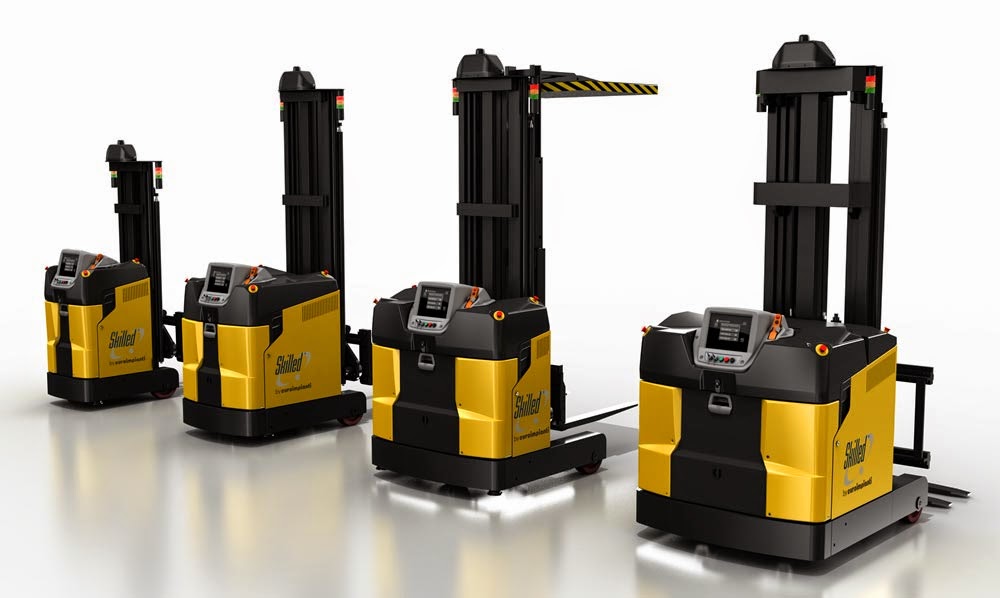
Autonomous forklifts gear up with QNX and HTML5

Warehouse robots need reliable realtime control. They also need an intuitive user interface. Can one OS handle both?

When it comes to forklifts, I am as dumb as they come. I had always assumed that one forklift is much like any other, aside from obvious differences in size and color. Boy, did I get that wrong. A quick perusal of Wikipedia reveals some 30 forklift types, ranging from “walkie stackers” (which, true to their name, are walked, not ridden) to “EX-rated lift trucks” (which, contrary to their name, aren’t designed to carry erotica but to be explosion proof).

Forklifts also come in driverless variants called automated guided vehicles, or AGVs. Case in point: the QNX-powered AGVs built by Euroimpianti, a global leader in automated warehouse systems. These vehicles can, without human intervention, load and unload trucks, as well as move materials from one area of a warehouse or factory to another. Moreover, they can operate 24/7, using a list of prioritized missions downloaded from a central management system.

As you might expect, Euroimpianti uses the QNX Neutrino OS in the realtime control systems of its AGVs. After all, predictable response times and high reliability — qualities essential to safe operation of a driverless vehicle in a busy warehouse — are QNX Neutrino’s stock-in-trade.

But here’s the thing: Euroimpianti has also decided to standardize on QNX Neutrino for the human machine interfaces (HMIs) of its operator panels. Why do that, when the HMIs could run on an OS like Windows Embedded or Android? The answer lies in the many features introduced in the QNX Neutrino OS 6.6 and the new QNX SDK for Apps and Media.

These features include a framework for creating apps and HMIs with industry-standard technologies like HTML5, JavaScript, and CSS, and a graphical composition manager that can seamlessly blend apps and graphical components created in HTML5, OpenGL ES, Qt, and other environments, all on the same display. In addition, the SDK offers secure application management, comprehensive multimedia support, mobile device connectivity, an optimized HTML5 engine, and other features for building mobile-class user experiences into embedded systems — including, of course, AGVs.

To quote Maurizio Calgaro, electronic engineering manager, Euroimpianti, “With its new QNX SDK for Apps and Media, QNX Neutrino enables us to create dynamic HMIs that leverage the latest Web technologies, including HTML5. Our operator panels and control systems can now run on the same, standards-based OS, and that means greater productivity for our developers and, ultimately, faster time-to-market for our solutions.”

The QNX SDK for Apps and Media includes an HTML5 environment to create and deploy applications.
Euroimpianti's QNX-based robotic systems also include Cartesian robots, anthropomorphic robots, and selective compliance assembly robot arms (SCARA). The systems are deployed internationally in the automotive, beverage, cosmetic, food, dairy, electrical, glass, and pharmaceutical industries. Learn more on the Euroimpianti Website, which includes many videos of the robots in action.

Using the same OS for both realtime control and user interface control.

2/22/2015

Bend it, shape it, any way you want it

Last year, at Embedded World 2014, QNX Software Systems demonstrated three systems built by its customers: a touch display that connects washing machines to the Web, an operator panel that controls forklifts and bulldozers, and an inspection system that detects cracks in gas pipelines. These systems perform very different functions, and operate in very different environments, yet they have one thing in common: the QNX Neutrino OS.

Fast-forward to Embedded World 2015, where, once again, QNX will showcase the remarkable flexibility of its OS technology, in everything from a medical device that saves lives to a robot that cleans carpets. Of course, the new demos aren’t just about flexibility. They also showcase how QNX technology can make embedded systems easier to build, easier to certify, and easier to use. Not to mention more reliable.

So if you’re at Embedded World this week, come on over and visit us at Booth 4-358. In the meantime, here's a quick peek at what we plan to showcase:

Demo #1: The autonomous vacuum
Chances are, the QNX booth will have the cleanest floor in all of Embedded World. And for that, you can blame the Neato Botvac robot vacuum.

This Botvac is one smart appliance: Before it starts to suck up dirt, it scans and maps the entire room so it can work as quickly and methodically as possible. It’s also smart enough, and quick enough, to maneuver around furniture and to avoid staircases.

To quote Mike Perkins, vice president of engineering at Neato Robotics, “our autonomous home robots need fast, predictable response times, and the QNX OS enabled our engineers to achieve very high performance on cost-effective hardware. The QNX OS also helped us create a software architecture that can quickly accommodate new features, giving us the flexibility to scale product lines and deliver compelling new capabilities.”

Check out this video of the Botvac in action:


Demo #2: The defibrillator
If you don’t already know, the QNX Neutrino OS is used in dialysis machines, infusion pumps, angiography systems, surgical robots, and a variety of other hospital-based medical devices. But it’s also used in mHealth devices that provide critical therapy or diagnostics when the nearest hospital is miles away. Case in point: the corpuls1, a defribrillator and patient monitor for fire fighters and other first responders, built by GS Elektromedizinische Geräte G. Stemple:


Demo #3: The medical reference demo
The QNX booth will also feature our latest medical reference demo, which integrates a suite of QNX, BlackBerry, and third-party technologies for building connected, safety-critical medical devices. Here is what the demo system looks like:


And here is a sample of what’s under the covers:

IEC 62304-compliant QNX OS for Medical
HL7, the international standard for transfer of clinical data
 User interface based on the Qt application framework
Java runtime engine
 Remote device management and end-to-end security of the BlackBerry BES12 architecture

Demo #4: The QNX SDK for Apps and Media
We released the first version of this SDK almost exactly one year ago. In a nutshell, it extends the capabilities of the QNX Neutrino OS 6.6, enabling embedded developers to create rich user interfaces and applications with HTML5, JavaScript, CSS, and other Web technologies. It also offers secure application management, comprehensive multimedia support, mobile device connectivity, an optimized HTML5 engine, and other advanced features for building mobile-class user experiences into embedded devices.

You can learn more about the SDK on the QNX Website. In the meantime, here’s the home screen of the SDK, showing several of its built-in applications and demos:


Demo #5: The [CENSORED] robot
What kind of robot, you ask? Sorry, you’ll have to wait until the first day of Embedded World, when we will showcase a video of this (very cool) QNX system in action.

Demo #6: The all-new QNX [CENSORED]
Again, I can’t tell you what this is. I can’t even give you a hint. I can mention, however, that it’s a brand new product that will run on an automotive demo system in our booth. But don’t be fooled by the automotive connection! The new product can, in fact, be used in a wide variety of devices, not just cars. Stay tuned.


Visit www.qnx.com to learn more about QNX at Embedded World, including presentations on IoT and safety-critical design. And while you're at it, download this infographic to see how flexible QNX technology really is.

1/19/2015

Breaking up is hard to do

Separation can be painful. But often, the failure to separate can result in even more pain over the long haul.

No, I’m not talking love, marriage, or other affairs of the human heart. I am talking software design. In particular, the design of complex software systems that must perform safety-critical functions. The software, for example, in a medical device, automotive ADAS unit, or train-control system.

In systems like these, separation is critical: software components must be cleanly isolated from one another. Otherwise, you risk the chance that the behavior of one component will inadvertently interfere with the behavior of another. For this reason, component isolation is a key thrust of functional safety standards like IEC 61508 and ISO 26262.

Several forms of interference, all undesirable.
Interference can take many forms. For instance, a component could improperly use file descriptors or flash memory needed by other components. Or it could enter a tight loop under a failure condition and starve a more-critical component of CPU time. Or it could write to the private memory of another component.

You could, of course, run every component on separate hardware. But that becomes an expensive proposition. Moreover, the market trend is toward hardware consolidation, which, for reasons of economy, merges previously discrete systems onto a single platform.

It’s important, then, to embrace software-based separation techniques. These include OS mechanisms to prevent resource deprivation, time starvation, data corruption, and so on. For instance, the adaptive time partitioning provided by the QNX Neutrino OS can ensure that a software component always gets a minimum percentage of CPU time, whenever it needs it. That way, other components can't prevent it from running, either unintentionally or maliciously.

Software separation is as much art as science. In fact, my colleague Yi Zheng goes further than that. She argues that there is as yet no precise methodology for separating system functions. There are no textbooks, no pat answers.

So is separation only a matter of asking the right questions? That would be an oversimplification, of course. Skill also comes into play, as does experience, not to mention a good dose of thoroughness. But really, you should read Yi’s article, “The Art of Separation”, in Electronic Design and judge for yourself.

10/09/2014

I've got to get me one of these!

Anyone who has grown up where the snow stays on the ground 6 months a year will know why. Heck, even folks who've never seen snow will understand.

If you're feeling particularly ADD, just jump to the 2:03 mark. But be sure to hang on to your shorts:

5/14/2014

The end of software testing? No, not really

Testing: no longer about establishing
the correctness of a system
A few years ago, I penned a whitepaper that contained these words:

    "No amount of testing can fully eliminate the bugs and security holes in a complex software system, as no test suite could possibly anticipate every scenario the system may encounter."

As it turns out, I wasn't whistling dixie. My colleague Chris Hobbs, who has forgotten more about software design that I could hope to learn in multiple lifetimes, notes that:

    "... a modern, pre-emptible, embedded operating system with about 800 assembler instructions in its core has more than 10300 possible internal states. To put this into perspective, the Eddington Number (the number of protons in the observable universe) is about 1080.

Don't know about you, but those numbers far exceed what my brain can grasp. And if that's not enough, the 10300 figure applies only to the OS core — it doesn't account for the huge number of additional states that are introduced when you start running applications and their supporting libraries.

So why bother with testing when you can only hope to exercise, say,
0.00000000000000000000000000000000000000001% of the system's possible states? It all has to do with a concept called confidence from use.

Rather than attempt an explanation here, I invite you to read a paper that Chris has published, titled "Testing as a road to confidence-from-use". Chris not only explores the concept, but discusses the degree to which confidence-from-use data gathered on one version of a system can be applied to a slightly modified version. Recommended for anyone interested in software testing or reliability.

4/24/2014

Flying around the world on solar power

Did you miss it? I missed it. And I really wanted to catch it. Earlier this month — while I was paying attention to gosh knows what — the Solar Impulse team unveiled the first solar-powered aircraft capable of flying around the world. It’s called Solar Impulse 2, and it will embark on its round-the-world tour in March 2015.

The Solar Impulse team thinks big, but they also think smart. For instance, they didn't try to build a globe-circling solar plane right off the bat. Instead, they took a stepwise approach and built a plane that could fly shorter hops — across a continent, for example. The lessons learned from building and flying that first plane, which successfully crossed Europe, Africa, and the US, helped the team develop Solar Impulse 2.

Not surprisingly, Solar Impulse 2 is larger than its predecessor. The wingspan has grown from about 64 meters to 72 meters, the weight from about 1600 kilos to 2300 kilos, and the number of voltaic cells from about 12000 to 17000. That’s a lot of batteries.

Mind you, the numbers tell only part of the story. The Solar Impulse 2 project also required the development of innovative materials and construction methods, including new electrolytes to boost the energy density of the voltaic cells.

This story isn’t just about technology. It’s also about human skill and endurance. For instance, to cross the Atlantic or Pacific ocean, the plane, which has a top speed of 90 km/h, will need to stay airborne for about 5 or 6 days. And that means the pilot will have to sit in an unheated, unpressurized cockpit for more than 120 hours in temperatures that could range from -40°C to +40°C. These guys aren’t just smart; they’re tough to boot.

Did I mention? QNX Software Systems is the official realtime OS partner for the Solar Impulse team, and the plane uses the QNX OS for several control and data communication functions. Which is, well, cool.

The plane is scheduled to launch in about 310 days. And this time, I’ll be paying attention. By the way, here's the part that I missed:


See previous posts on the Solar Impulse project.

4/09/2014

Japan's high-tech innovations take on natural disasters

Guest post by my inimitable colleague Noko Kataoka.

Noko Kataoka
When I’m talking to my family in Japan, the conversation often turns to the weather. Not because we have nothing else to talk about, but because the weather is such a serious subject in their region. They experience heavy rainstorms in early summer (followed by scorching heat that lasts for over two months), ferocious typhoons in the fall, and blizzards in the winter that can drop up to 50 cm of snow overnight. Every time I hear a severe weather report I need to call my family and make sure they’re okay.

And, of course, Japan is known for its earthquakes. The country is still working to recover from the “311” (March 11, 2011) disaster, one of the worst earthquakes and tsunamis in history, which killed more than 18,000 people. The country has had to put a lot of thought into how more lives could be saved when Mother Nature chooses to strike again.

Logo of the
Saigai Taisaku Expo
The good news is, Japanese people are very good at advancing technology to address their unique environment. Government agencies and businesses work together on innovative ways to respond to environmental challenges. The country even has tradeshows dedicated to technologies for coping with natural disasters. For instance, the Saigai Taisaku Expo (Disaster Response Expo) showcased many ingenious solutions this year — from highly sophisticated portable toilets for evacuation camps to smartphone apps for earthquake warnings. Here are some solutions that I found interesting:

  • An unmanned airplane for establishing radio communications in isolated communities that have suffered infrastructure damage.
     
  • A helmet loaded with a head-lamp, radio, earthquake sensor, and wireless communications unit. The helmet not only protects you from physical shocks but also sends emergency messages for safety confirmation, evacuation guidance, and more.
     
  • An earthquake estimator that uses earthquake forecast information issued by the Japan meteorological agency to estimate the magnitude of an imminent quake and how long before the shock hits. It can be integrated with public broadcasting systems or digital signage to guide people to safety.
     
  • A smartphone navigation app especially designed for natural disaster situations. Using information from GPS and camera, the app displays directions for designated evacuation areas.
     
  • An unmanned 3D radar system for estimating damage to buildings. Okay, your building is still standing after a big earthquake — but how do you know if it’s safe to go in?
     
  • A public information system that consolidates and manages big data collected by the crisis management information center. In the state of emergency, people can access to emergency-response information they need from their mobile devices.
     
It is particularly interesting to see how new innovations are made possible by technologies such as smartphones and cloud connectivity. We have little immediate influence on how Mother Nature behaves, but people can engineer solutions to help survive natural disasters. And with global climate change causing unexpected weather across the planet, Japan’s innovations in connected systems for environmental challenges may prove useful in other parts of the world, too.